


OK, so here’s the thing. Everything I said about the last game goes. Everything. If you liked the last game, get The Siege of Spinner Cay, too; if you haven’t played the last game, read my review of the last game and decide if you want to. (Spoiler alert!: You do.) The graphics are the same, the controls are the same, and the freaking awesome hilarity and (generally) well-balanced puzzles are the same. (Not literally. There are different jokes and puzzles, but they’re of the same high quality.) This game is a Total Winner, uppercase, just like the one that came before it, and just like the ones that come after it. (Well, with one exception, but we’ll get to that in a later review.)
Now that I have the above paragraph as a solid intro and summary, I guess I need to come up with some body paragraphs.
Hmmm.
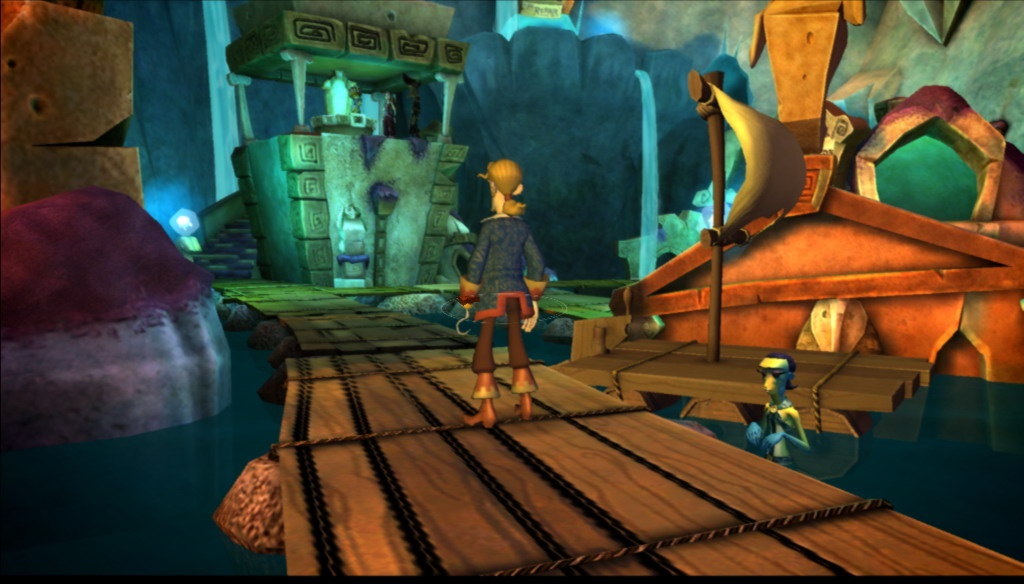
Well, OK. A brief recap for those rule-breakers who’ve decided to just keep reading this review, even though they didn’t play the last game or read my last review. Tales of Monkey Island is a series of episodic—episodic meaning “really short”—point-and-click adventure games, and The Siege of Spinner Cay is the second game in that series. They star Guybrush Threepwood, mighty pirate, in his quest to squelch a plague that he embarrassingly let loose on the world. To do this, he needs to obtain a mystical sponge, and you need to help him do that.
Gameplay involves picking up random things and using them with other random things to solve puzzles. For example, you might attach a plastic pirate hook to a cannon’s ramrod in order to pluck a sword out of the ocean in order to break yourself out of captivity. You basically keep doing things like that until you win the game, and it’s totally awesome. You also can’t ever die, or even really lose the game; the game encourages you to explore your whims without fear of having to restart because you accidentally walked on a bridge too many times, and oh darn, now it’s collapsed. (Yeah, that’s right—I am calling you out, Kings Quest II.) That, too, is totally awesome.
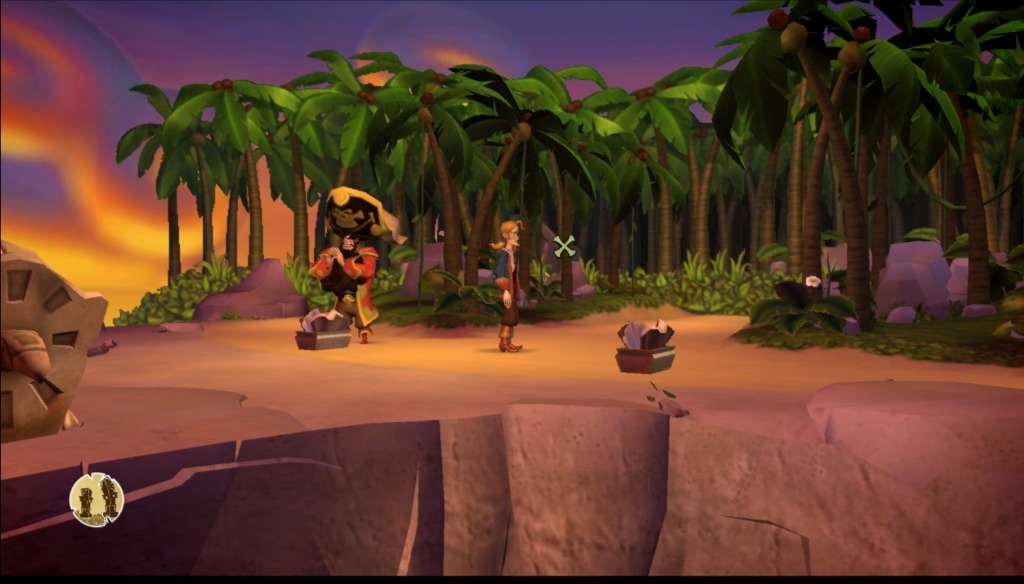
There are a few new and exciting things to talk about in this game, in comparison with the last one. In this game, both LeChuck (arch-nemesis to Guybrush) and Elaine (lovey-dovey to Guybrush) get way more screentime—moreso, even, it seems, than in any of LucasArts’s actual full-length MI releases. It’s neat to spend time with these characters, who are arguably more important to Guybrush than anyone else in the world, and work with them to solve puzzles, instead of interacting with them almost exclusively via cutscene, like in previous games. There’s also a new character, referenced but not introduced in the previous game, who’s the most fun MI character since Murray, the demonic talking skull. She won GameCola’s award for “Best New Character” in our recent year-end awards, so you know she must be great. (Of course, we also gave our award for “Best New Peripheral/Accessory” to—I’m not making this up—”a cardboard box,” so maybe we’re unreliable.)
The game also has one of the most awesomely clever and meta puzzles I’ve ever seen, comparable to the Mad Libs puzzle in Telltale’s first Wallace & Gromit adventure game. Unfortunately, this puzzle also leads directly into the most unintuitive and horrible puzzle I’ve ever seen. It’s difficult to describe this without spoiling the game at all; if you don’t mind minor spoilers, highlight the following text to read about this puzzle: [There’s a part of the game where, to progress, you need to ask for a certain character’s help. If you tell Guybrush to ask this person for help, Guybrush says, basically, “there is absolutely no way I am going to ask that person for help. Ever. It will never, ever, ever happen.” However. If you try to give this character the specific item that you need help with, Guybrush will qualmlessly do so, and then qualmlessly ask for this character’s help. This, obviously, makes no sense, and makes the puzzle obnoxious to solve, rather than enjoyably challenging.]
If you were a weenie and didn’t highlight the text, let’s just leave it at this: this puzzle makes the goddamn monkey wrench puzzle from Monkey Island II seem totally logical.
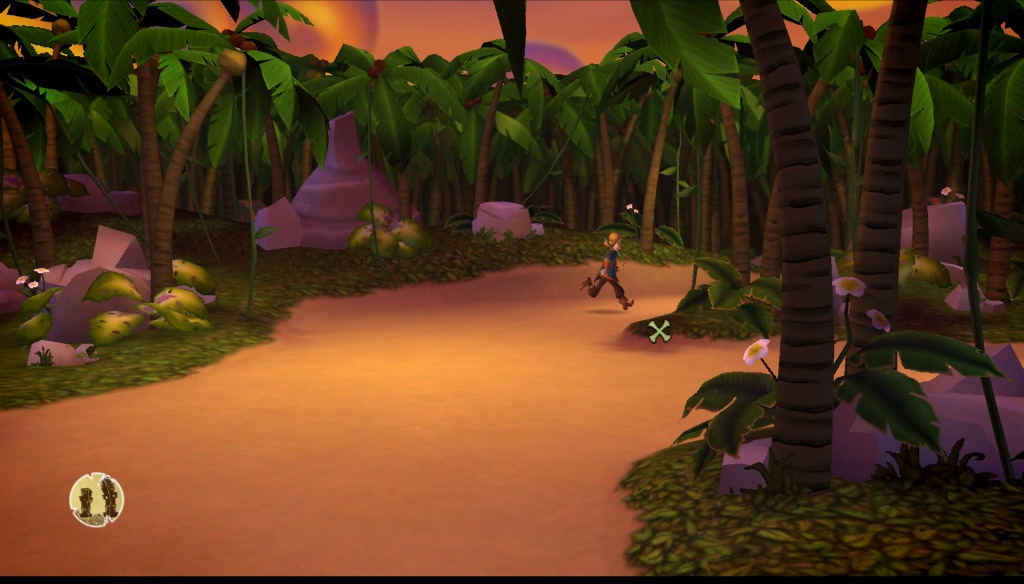
We (“we” being myself and my snuggle-umpkins, with whom I was playing through this game) had one more problem related to this particular puzzle. After a long while of not knowing what to do, we decided to be weenies ourselves and turn on the game’s built-in hint system, to help us figure out what the frak we were supposed to do next. Now, this may have been a glitch exclusive to the review copy we were playing, but the only hint we ever received was that there was some item, somewhere, that we needed to pick up, and do something with. No matter where we went or what we did, this was all the game would tell us. It refused to give us any more details, like, for example, where this item could be found, or what it even was.
The best part, though? Not only was the game being annoyingly vague, but it was also lying to us. There WAS no item we had to pick up; in fact, there was no item we COULD pick up. There was something else entirely that we had to do, as described in the super-secret white-colored text above. So that was a little weird.
Also: Unfortunately, but totally expected, The Siege of Spinner Cay continues with the awkward click-and-drag walking controls of the first TMI game, instead of just allowing you to click where you want to go, like the classic LucasArts adventure games, and like Telltale’s own Sam & Max series.
WARNING: OLD-FOGEY RANT
I talk about this kind of thing all the time, but I still think it’s important for any developers reading this to know: You don’t have to ditch the point-and-click interface. You really, really don’t. Everyone loves it, and it works great. You don’t have to try to create something more “modern,” because the more “modern” control schemes just don’t work for this genre. They didn’t work in Grim Fandango (at all), they didn’t work in Escape from Monkey Island, and they don’t really work here, either. Just stick with the pointing and the clicking; it’s intuitive, it’s easy, it’s understandable, and everyone likes it and is comfortable with it.
IT’S OK; THE OLD-FOGEY RANT IS NOW OVER
In terms of replay value, the game is short, and it’s very fun, but those are basically the only reasons you’d be playing it again. There are no different difficulty modes (as in Curse of Monkey Island), and no Achievements or anything else for you to go back and collect. It’s the sort of game you’ll want to come back to years later when you’ve forgotten all the answers to all the puzzles and want to have another good time; it’s not, however, the sort of game you’ll be playing for weeks upon weeks after you buy it. (In fact, you’ll probably only be playing it for a weekend, or maybe even just a day, since it clocks in at about 5-6 hours, dependent upon how long it takes you to figure out the Worst Puzzle Ever.)
I know I’ve been more critical than positive in this review, so let’s try to make up for that now with some obnoxiously large font:
THIS GAME IS REALLY REALLY FUNNY.
As in, laugh-out-loud funny. And I’m not just talking about typing “LOL” into an AIM chat window, because you’re not fooling anyone, and we all know you’re not really laughing out loud; I’m talking about legitimately laughing out loud. Both of us. Me and my snugle-umpkins. It’s like the developers were actively trying to disprove the Mid-Boss. Moreover, the puzzles in this game are more clever than those in other recent adventure games, and they have more character to them. Tailor-made! That’s the phrase I’m looking for. Unlike in other recent adventure games, the puzzles don’t feel like they came from the Vault of Unused Puzzle Ideas; they feel like they belong to this adventure game in particular.
The controls are bad, and there’s that one awful puzzle, but you might not even notice, because of all the fun you’ll be having, especially if you play through the game with a friend, or with your own snuggle-umpkins. The “so basically” of Tales of Monkey Island, so far, is this: You aren’t going to find a more entertaining modern-day adventure game.


Concerning the unpleasant puzzle you pointed out: Maybe it’s just the way I think, but the whole “meta puzzle” thing got taken a step further by the solution.
The person you were talking to is stubborn and wants to solve the puzzle on their own, but you basically solve it for them because they are incapable of doing so. Once that’s done, it’s a total turnaround where you, the player, are stubborn and want to solve the puzzle for yourself, but you know the only way it’ll get solved is if you ask for their help.
In both cases, the solution is essentially to get help even though someone is resolved to figure it out without help. I dunno; it made sense to me, but I didn’t come to that conclusion immediately.
I’m not opposed to the asking for help at all. My main problem is that, if you try to ask for help one way, Guybrush totally refuses; if you try a different way, though, Guybrush will do so…and there’s no reason why the second way would work, and not the first.
It took me forever to figure out the puzzle, because I didn’t think to try the second way, since Guybrush told me he’d never in a million years ask for this person’s help.
Fair enough. I was thinking more about the nature of the puzzle–figuring out how to get around someone’s stubbornness.
Sort of like the timed puzzle a little later on; you know the only real solution is to bring your timed goods to a specific place, but you always run out of time if you do it the way that makes sense. It’s a matter of finding alternate ways to accomplish what logically must be the only solution, even though it’s clearly impossible.
I think what’s been going on is that I’ve been paying close attention to the responses I get; Telltale usually makes it very clear when a particular “solution” is an absolute waste of time, but I’ve been learning how to recognize when an error response is more of a subtle “Well, you’re kinda right, but that’s not quite it” response.
When Guybrush says that never in a million years would he get help from this person, I ran it through the filter of Guybrush talking in character, not Guybrush explicitly telling the player that the solution he’s chosen is invalid.
Again, this is just the way I’m wired to think; I’ll bet you five doubloons that you figured out the absolute final puzzle of Curse of Monkey Island long before I did. I had to use a walkthrough because, the way I think, the solution made absolutely no sense and shouldn’t have worked at all.
Aha! See, I totally did not see it as a “you’re kinda right” response. It definitely came across to me as a “you are totally wrong, and you have to find a different way to do this” response. That’s why it was confusing, to me, that asking him for help a different way was the solution.
It would be a lot easier to talk about this if I could be explicit.
SPOILER ALERT!!
I click “talk” on LeChuck, and tell Guybrush to ask LeChuck to help pry out the turtle. Guybrush tells me no way, because he doesn’t want LeChuck’s help. I click on the prying tool, and click on LeChuck, to give the prying tool to LeChuck. Guybrush says, OK, sure, good idea—why don’t I ask LeChuck for help? (Well, OK, maybe not in those exact words.)
That was my problem—I had already eliminated LeChuck as a possible answer, because Guybrush told me he’d have nothing to do with LeChuck. It doesn’t make sense to me that if I try to give the prying tool to LeChuck, all the sudden Guybrush is OK with asking for his help. I don’t understand why Guybrush has had a change of heart between my telling him to ask LeChuck for his help, and my telling him to give LeChuck the prying tool. The two answers, so far as I can tell, contradict one another entirely. It’s possible that I missed some dialogue that explained this, though.
I’m not sure if I’m actually refuting/arguing with anything you said, but I want to make it clear why I think that solution was bad.
I completely get what you’re saying; my original response was more of a “I absolutely understand why you might have that problem, but I personally didn’t have much of a problem with the puzzle, and here’s why it kinda made sense to me” response.
I don’t think you missed any contradicting dialogue; realistically, there’s no reason that only one of the two methods should yield results, even though there’s essentially nothing different in their respective approaches. It’s possible that you have to try both methods to be successful (sort of like nagging Guybrush to do it until he caves).
(Continuing SPOILER ALERT!!)
My thought process when solving the puzzle was, “Guybrush won’t ask for help, but he might be willing to thrust the crowbar at LeChuck and see if LeChuck will pry out the turtle without technically being asked to do so.”
Ah! OK, that makes sense.
I had trouble for ages on this puzzle – particularly because…
(SPOILER ALERT)
…I didn’t check the clam for the pearl. After that I thought it was pretty straight forward. I liked the nasty things you could make Guybrush do to LeChuck.
(ONGOING SPOILER ALERT)
I actually discovered the pearl by accident. I make it a habit to examine absolutely everything I put into my inventory; the pearl just fell into my lap that way.
And everything about the dialogue options with LeChuck was fantastic.
“Look at… yourself”.